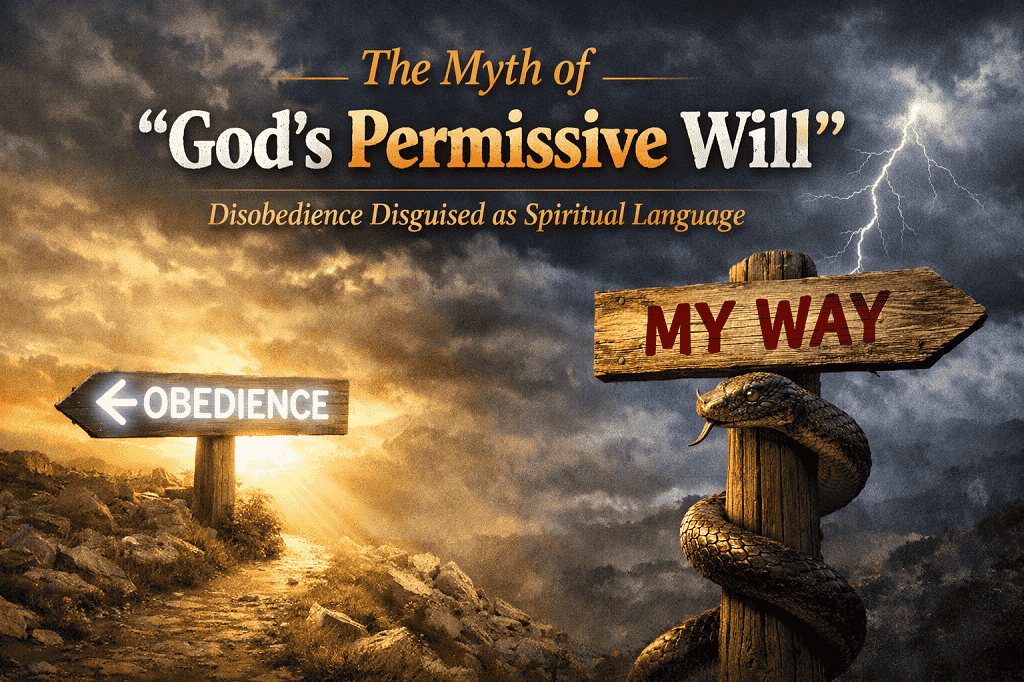
One of the most common phrases used in Christian circles today is “the permissive will of God.”
People often use it to explain decisions that seem to contradict clear divine instruction. When something goes wrong or when a choice feels questionable, it is sometimes explained away by saying, “Maybe it was just God’s permissive will.”
But an important question must be asked:
Does the Bible actually teach that God has a “permissive will”?
Or is it possible that what many people call the permissive will of God is simply disobedience wrapped in a spiritual language?
This is a question that requires honest reflection and careful examination of Scripture.
When We Convince Ourselves God Said “Yes”
Many believers have experienced moments when they felt strongly that God was saying “no” about a certain decision.
Yet instead of accepting that answer, they wrestled with it internally.
They prayed again.
They waited for another sign.
They searched for another interpretation.
Eventually, the resistance inside them began to fade – not because God changed His mind, but because they convinced themselves He did.
How does this usually happen?
- God clearly says no.
- The person strongly desires the opposite.
- They keep pushing until God becomes silent.
- They interpret that silence as approval.
But silence from God does not automatically mean permission.
Sometimes silence simply means God has already spoken.
When Silence Is Mistaken for Permission
The danger of ignoring God’s clear instruction is that eventually the heart begins to reinterpret reality.
Instead of asking, “What did God say?”, the question becomes:
“How can I make this decision fit into God’s will?”
At that point, people may begin to say things like:
- “Maybe God is allowing it.”
- “Maybe this is His permissive will.”
- “Maybe God is okay with it now.”
But in many cases, what is happening is not divine permission, it is human justification.
The heart begins to search for a spiritual explanation that makes disobedience feel acceptable.
What the Bible Actually Says About God’s Will
When Scripture speaks about the will of God, it does not describe it as flexible, negotiable, or permissive.
Instead, the Bible presents God’s will as something good, acceptable, and perfect.
The Apostle Paul writes in Romans 12:2:
“That ye may prove what is that good, and acceptable, and perfect will of God.”
Notice what the passage says.
God’s will is described as:
- Good
- Acceptable
- Perfect
It is never described as permissive.
If God’s will is perfect, why would He need an imperfect or compromised version of it?
The idea that God maintains a secondary, less-ideal will for believers is a concept many assume exists in the Bible but Scripture never clearly teaches it.
The Misunderstanding of Balaam
One of the most common biblical stories people use to support the idea of God’s permissive will is the story of Balaam.
The account is recorded in Numbers 22.
King Balak wanted Balaam to curse Israel, so he sent messengers offering rewards if Balaam would come.
When Balaam first asked God about it, the answer was crystal clear:
“Thou shalt not go with them; thou shalt not curse the people.” (Numbers 22:12)
God said no.
But Balaam was attracted by the rewards and continued entertaining the idea.
Eventually, God told him he could go if the men called him again.
Some interpret this moment as God changing His mind or giving Balaam permission.
But the next events reveal something very different.
As Balaam traveled, the Bible says the anger of God was kindled against him. An angel of the Lord stood in the road to oppose him. The story then describes Balaam’s donkey seeing the angel and refusing to move forward. The angel later told Balaam that his path was reckless and perverse before God.
This raises several important questions.
If God truly permitted Balaam to go:
- Why did God send an angel to stop him?
- Why was God angry about the journey?
- Why did the angel declare Balaam’s path wrong?
The evidence suggests that God never truly endorsed Balaam’s mission. Instead, Balaam pushed until he convinced himself God allowed it. His heart was driven by greed. Scripture later confirms this motivation.
In 2 Peter 2:15, Balaam is described as someone who:
“loved the wages of unrighteousness.”
God allowed Balaam to proceed – not because the mission was approved – but because the journey would expose the corruption in his heart.
When Disobedience Is Spiritualized
Sometimes believers unintentionally use spiritual language to justify choices that conflict with God’s instruction.
Instead of saying, “I chose to disobey,” the explanation becomes:
- “God allowed it.”
- “It must have been His permissive will.”
But obedience to God has always been straightforward.
Jesus said in John 14:15:
“If ye love me, keep my commandments.”
There is no suggestion that believers should negotiate with God’s instructions or reinterpret them until they become comfortable.
God’s “yes” is yes, and His “no” is no.
The Danger of Trying to Manipulate God’s Will
Trying to manipulate God’s will is spiritually dangerous because it slowly trains the heart to override divine conviction. Over time, a person may begin to trust their own desires more than God’s voice. That is why Scripture repeatedly warns believers to remain sensitive to God’s direction.
When God speaks clearly, the safest response is simple:
Obey.
Not reinterpret.
Not negotiate.
Not repackage disobedience in spiritual terms.
Just obey.
Walking in God’s Perfect Will
The will of God is not a puzzle designed to trap believers. It is the perfect path designed to guide them.
When we trust God enough to accept His answers – both yes and no – we place ourselves under His protection and wisdom.
Sometimes His “no” protects us from things we cannot yet see. Sometimes His “yes” leads us into blessings we never expected. But in every situation, His will remains perfect.
Final Thought: Stay Obedient
It is easy to manipulate circumstances, reinterpret silence, or search for explanations that make difficult decisions feel justified.
But obedience to God requires something deeper than explanation.
It requires surrender.
God’s “yes” is yes.
God’s “no” is no.
There is no need to invent a “permissive will” to soften His instructions.
Instead, choose the path Scripture consistently calls believers to follow:
Trust God.
Obey His voice.
And refuse to manipulate what He has already made clear.
God bless you.