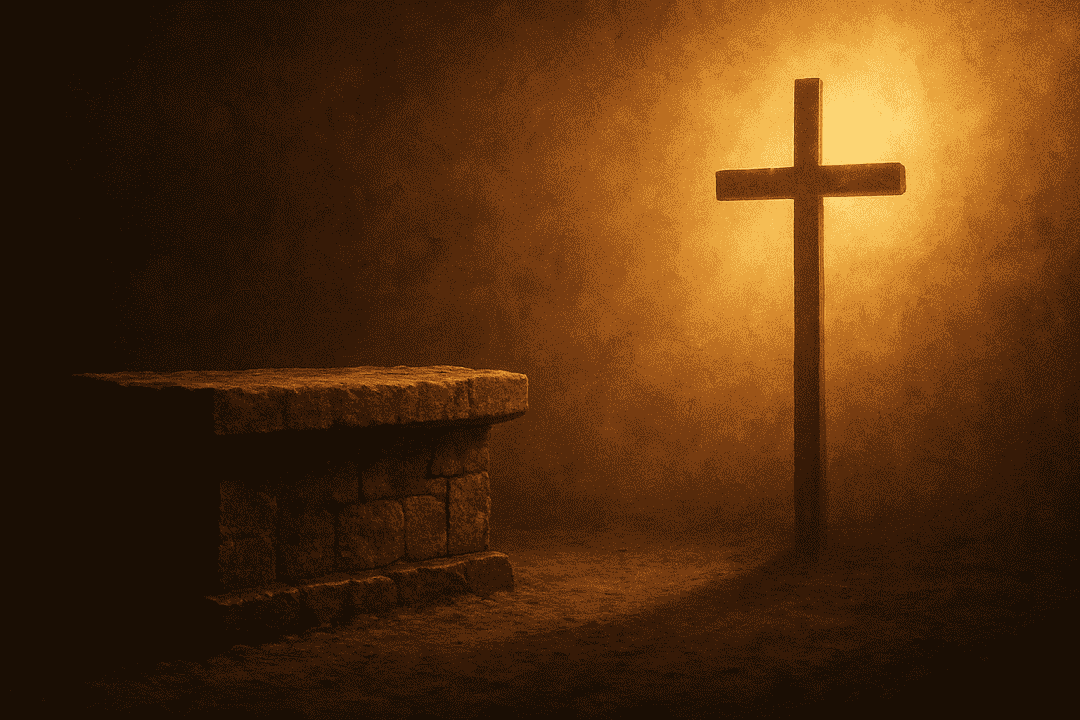
“For thou desirest not sacrifice; else would I give it: thou delightest not in burnt offering.”
— Psalm 51:16
This verse immediately confronts a deep theological question:
If God did not desire sacrifices, and if He did not delight in burnt offerings, then what was the point of all the ceremonial rites in the Old Testament?
If the blood of bulls and goats could not take away sins, why did God command it at all?
God Is Not a Vampire, and Not a Time Waster
Let’s be clear about something foundational.
God is not a vampire.
He does not thirst for blood.
He does not waste time, effort, or resources.
He is all-wise, intentional, and purposeful.
Scripture confirms this plainly:
“For it is not possible that the blood of bulls and of goats should take away sins.”
— Hebrews 10:4
And again:
“In burnt offerings and sacrifices for sin thou hast had no pleasure.”
— Hebrews 10:6
So we must ask the obvious question:
Why institute a system that could never accomplish the goal of removing sin?
The Priests Were Busy but Sin Remained
The book of Hebrews pulls back the curtain on the Old Testament priesthood:
“And every priest standeth daily ministering and offering oftentimes the same sacrifices, which can never take away sins.”
— Hebrews 10:11
Day after day.
Year after year.
The same sacrifices.
The same rituals.
Yet sin remained.
The priests were busy but not because the sacrifices were effective.
So again: Why?
Were the Old Testament Practices Just Religious Activity?
Did Moses give Israel these practices just to keep them busy?
In a sense, yes. But not because God needed it.
God never needed sacrifices. The people did.
Israel’s Deep Problem: Unbelief
The real issue was not sin alone, it was unbelief.
Israel had just come out of Egypt, a land of visible gods, physical idols, and tangible rituals. Their mindset was shaped by what they could see, touch, and feel.
Leaving them to walk purely by faith would have been dangerous. In fact, Scripture shows us how fragile their faith was. Moses was gone for just forty days, and they made a golden calf. They could not fathom a God they could not see. They could not trust a God who did not give them something physical to hold onto.
They needed daily religious activity—something that looked familiar, something structured, something visible—to keep their hearts oriented toward God.
Ceremonial Laws as a Temporary Measure
The ceremonial laws were not proof of God’s need for sacrifice; they were proof of man’s inability to live by faith.
Moses had to substantiate God to a people who demanded proof. The sacrifices were not about cleansing sin. They were about managing unbelief. They were training wheels, never meant to be permanent.
Jesus: The Perfect and Final Sacrifice
Then came Jesus.
Unlike animal sacrifices, His offering was not symbolic or repetitive—it was perfect and final.
Through His sacrifice:
- Sin was dealt with once and for all
- The veil was torn
- The Holy Spirit was made available to dwell inside us
Now, God no longer relates with us through rituals, altars, or repeated sacrifices—but through faith.
Faith Is the Standard God Always Wanted
Scripture makes it unmistakably clear:
“But without faith it is impossible to please him.”
— Hebrews 11:6
Faith was always God’s goal.
The Old Testament system existed because the people could not handle it yet.
But now, in Christ, we are called to live by faith – not by ceremonies.
The Blood That Truly Speaks
Animal sacrifices for sin are no longer needed.
Not because God changed His mind—but because the real solution has come.
The blood of Jesus speaks.
And it is enough.
No more bulls.
No more goats.
No more repeated offerings.
Just faith—rooted in a finished work.
Final Thought
God never desired sacrifice.
He desired faith.
Sacrifices were temporary tools for unbelief.
Christ is the eternal answer.
And now, faith is not optional, it is the way.